The problem
Lipid nanoparticles (LNPs) are the delivery vehicle behind mRNA therapeutics — including the COVID-19 vaccines. Every new formulation is characterized by its encapsulation efficiency (EE%): the fraction of input nucleic acid that ends up inside the particle rather than free in solution. High EE is one of the first go/no-go metrics in LNP development, and it is measured empirically for nearly every new formulation.
That empirical bottleneck is the target here. If a predictive model can rank-order candidate formulations before synthesis, wet-lab teams can front-load the promising ones and skip the obvious losers. Even an imperfect model that narrows the search space is useful.
The catch is data. Published LNP literature is heterogeneous: different labs report different subsets of formulation parameters, assay conditions vary, and EE values reflect different measurement protocols. The signal is there, but so is a lot of noise.
Approach
I'm developing LNP-EE-Predictor as an open-source pipeline in collaboration with Constantinos Skevofilax, trained on the LNP Atlas dataset — 1,092 formulations curated from peer-reviewed literature. The project explores two complementary strategies:
- XGBoost baseline — a high-capacity gradient-boosted tree that extracts signal from rich feature engineering across all 636 usable rows.
- Physics-informed neural network (PINN) — a smaller network trained on a 93-row subset with the full feature vector, plus three physics residual terms encoding domain constraints.
Both models are evaluated the same way: GroupKFold cross-validation grouped by paper DOI. Random-split validation on this data is misleading because rows from the same paper share confounders — measurement protocol, buffer composition, operator technique, lipid lot. GroupKFold forces the model to generalize across papers, which is what matters if you want to use it on a new formulation from a new lab.
Results
| Model | OOF R² | OOF RMSE | Rows | Features | CV strategy |
|---|---|---|---|---|---|
| XGBoost | −0.032 | 21.88% | 636 | 88 | GroupKFold (paper DOI) |
| PINN, 7-feature | 0.438 | 11.25% | 93 | 7 | GroupKFold (paper DOI) |
| PINN, 7-feature | 0.580 | 10.12% | 93 | 7 | Random 80/20 (leakage-prone) |
The honest number is the middle row: R² ≈ 0.44 on out-of-fold cross-paper prediction using the PINN. The XGBoost baseline is worse than the mean predictor on cross-paper splits, which is a real and instructive result — not a bug to hide.
Why is XGBoost R² negative?
A previous iteration reported XGBoost R² ≈ 0.136. That number included a data leakage bug: the cleaned target column (encapsulation_efficiency_clean) was inadvertently retained as an input feature after the EE-cleaning step. Fixing the leak dropped honest R² to −0.032.
Both the XGBoost and the PINN results reveal the same underlying difficulty: cross-paper generalization from heterogeneous LNP literature is hard. Root-cause analysis suggests:
- Within-paper EE variance ≈ between-paper EE variance (both ~0.02 in fraction units)
- Roughly half of the EE variance is explained by unmeasured, paper-level confounders that no formulation feature can capture
- Feature coverage is uneven — many published papers omit key formulation details, so the model has to impute or drop
Dataset cleaning
Getting the dataset from 523 usable rows to 636 involved:
- Fixing 174 rows with corrupt
±encoding in the source CSVs - Parsing range-formatted EE values (e.g.
"80–85%") and dual-assay reports - Correcting 6 broken cKK-E12 SMILES against PubChem CID 71555845
- Nulling 32 DSPE-2armPEG2000 SMILES that had valence errors (falls back to frequency encoding)
Cleaned data is committed as data/lnp_atlas_cleaned.csv — the goal is that anyone reproducing the work starts from the same numbers.
Physics-informed neural network
The PINN adds three physics residual terms (R1, R2, R3) to the loss function, encoding first-principles constraints on how formulation parameters should relate to EE. On the 93-row subset with full feature coverage, this halved RMSE relative to a comparable MLP without physics constraints. The tradeoff is the small labeled dataset — the physics prior is doing real work compensating for data scarcity.
Expanding the PINN training set is the next major work item. Every paper that reports a full formulation vector unlocks new training examples.
Interactive dashboard
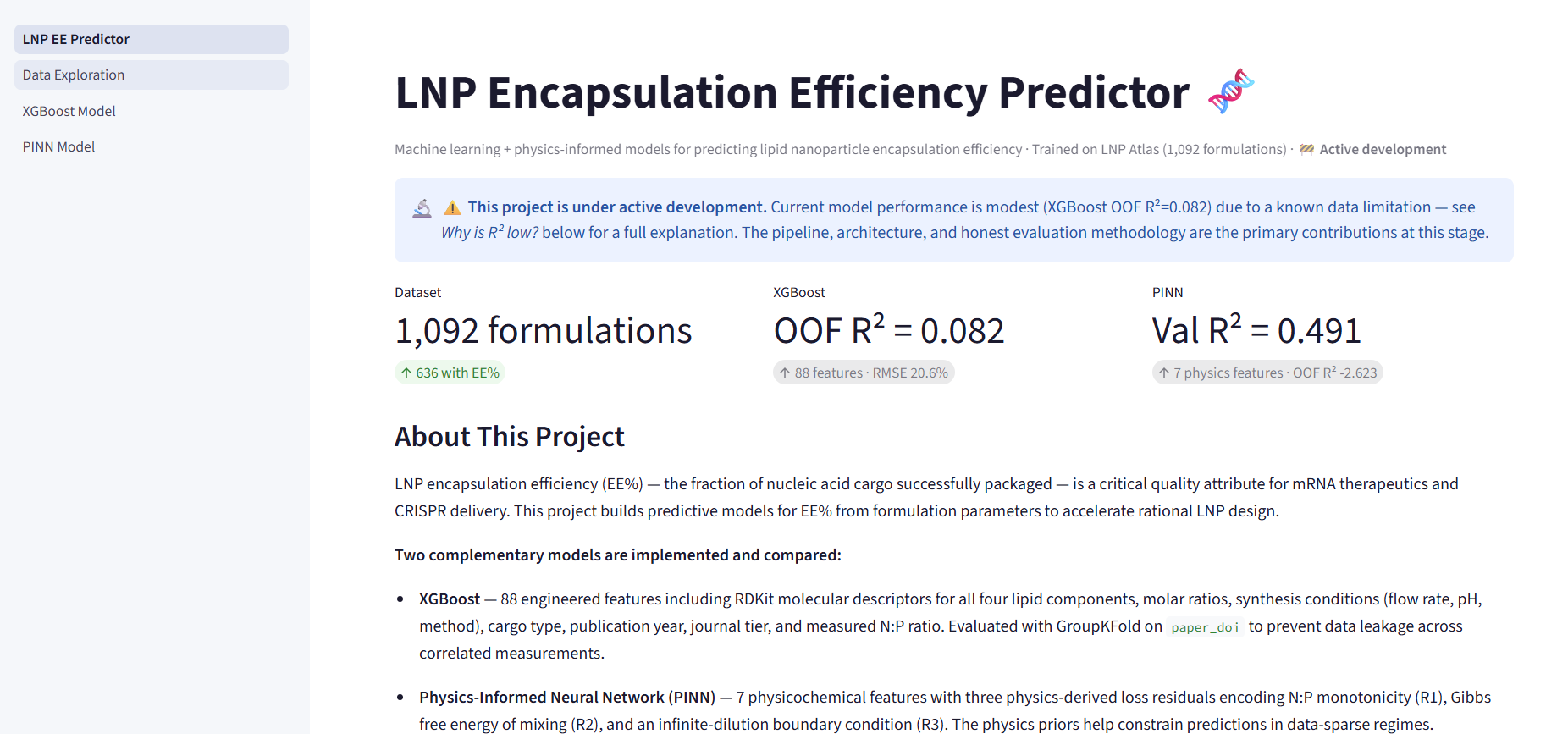
The Streamlit dashboard exposes data exploration, both model comparisons, and an interactive predictor where you can enter a formulation and get a predicted EE% back:
Hosted on Streamlit Community Cloud, which sleeps after inactivity — the first load can take 30–60 seconds. Open the dashboard in a new tab →
What's next
- API endpoint — Dockerized FastAPI service so the model is programmatically callable, not just interactive.
- Expand the PINN dataset — the 93-row subset is the current ceiling; growing it toward 300–500 rows would likely push honest R² past 0.6.
- Public predictions log — every prediction requested through the API gets logged (formulation + predicted EE), so if a user later measures the actual EE and reports it, we can grow the dataset from real usage.
Links
- Repository on GitHub — code, cleaned data, notebooks
- Live Streamlit dashboard — cold-start warning above
- Data source: LNP Atlas at the Korea Institute for Science and Technology